LocaLuv
- 4.2
- Rating
- 100.00K
- Installs
- Free
- Price

 Analysis by App-foxy
I approached LocaLuv as a social app for people who want to meet someone nearby rather than browse an enormous, impersonal network. That local focus is its most interesting idea: instead of treating every possible connection as equally useful, it encourages you to think about distance, availability, and whether a conversation could realistically move beyond the screen.
My overall impression is positive but measured. The app is free to install, aimed at mature users, and developed by MotionMedia. It has a 4.1 average from around 2.8 thousand ratings, with more than 100 thousand installs, so it has enough public use to feel like a real community rather than an empty experiment. Still, a location-oriented social app depends heavily on the people near you. The experience can feel purposeful in one area and noticeably quieter in another.
How the local approach feels in everyday use
The first thing I would tell a friend is that this is not the best choice if you want a huge, endlessly refreshing catalog of profiles. Its appeal is narrower and more practical. The point is to find people who might actually be part of your daily surroundings, which can make a promising conversation feel more realistic. You are not only asking whether you like someone's profile; you are also considering whether meeting would be convenient.
You May Also Like

 AccuWeather: Weather Radar
AccuWeather Review: A Quick, Clear Forecast for Everyday Decisions
For everyday plans, the best forecast is the one you can understand quickly. AccuWeather makes rain timing, radar, and local conditions easy to act on, with a few trade-offs.

 Hill Climb Racing
Why Hill Climb Racing Still Turns Crashes Into One More Run
A tiny car, a bumpy hill and one more upgrade: Hill Climb Racing keeps resurfacing because its simple chaos makes every near-miss feel personal.

 AliExpress - Shopping App
AliExpress Makes Global Shopping Feel Personal, but Shoppers Bear the Risk
AliExpress turns a global marketplace into a pocket-sized discovery engine. Its reach is useful, its shopping loop compelling, and its trade-offs easy to miss.

 Lords Mobile: Kingdom Wars
Lords Mobile Is a Kingdom-Building Routine, Not a Quick Match
A case-by-case verdict on the building, battles, device demands, and social commitments that make Lords Mobile rewarding for some players and exhausting for others.

 PDF Scanner app - TapScanner
TapScanner Makes Paperwork Easier to Capture, Check, and Share
TapScanner makes scanning with a phone feel less like a rescue operation and more like a dependable step in getting work done. Its capture tools are useful, though not flawless.

 Block Blast!
 Shows How Much a Puzzle Game Can Leave Out
A quiet grid game shows why puzzle players increasingly value instant clarity, repeatable skill and low-pressure play—and where the genre still needs to catch up.
More From Our News Desk
View All News


That makes the app especially suitable for someone who has recently moved, spends time in a new neighborhood, or wants social possibilities closer to home. It can also suit people who are tired of conversations that remain permanently online. On the other hand, users in a small town or an area with few active members may find the local angle limiting rather than helpful.
I like this trade-off because it gives the service a clear identity. Many social and dating-style alternatives compete by offering more profiles, more filters, or more constant activity. LocaLuv instead makes proximity part of the decision. That can reduce wasted time, although it also means the quality of your experience is tied to your surroundings.
The app is listed for mature audiences aged 17 and over. I would treat that as a reminder to use normal online-social caution: avoid sharing sensitive personal details too quickly, keep early meetings in public places, and do not assume that a nearby profile is automatically trustworthy. Local discovery can be convenient, but it also makes privacy awareness more important than it would be in a completely location-neutral community.
What I noticed about speed expectations
For a social app like this, perceived speed is less about dramatic visual effects and more about how quickly you can move between discovery, profile decisions, and conversation. I found the concept easiest to appreciate when I used it with a simple goal instead of trying to inspect everything at once. A short session focused on checking nearby possibilities feels more manageable than treating the app as a full-time social feed.
The current version is 1.1.3, and that suggests a relatively early stage of the product's life. I would not expect the same depth or polish as a long-established social platform with years of refinement. That is not automatically a problem, but it changes how I judge the experience: clear navigation and dependable basic actions matter more than an enormous collection of extras.
One practical tip is to decide what you are looking for before opening the app. If you want a nearby conversation, spend time writing a profile that explains your personality and availability instead of endlessly browsing. If you are simply curious, set a short session limit. This approach reduces the feeling of scrolling without direction and helps you judge whether the local pool is genuinely useful for you.
I would also avoid judging the app solely by the first few minutes. A local service can appear slow or uninteresting when there are few relevant people available at that exact moment, even if the app itself is responding normally. In this case, “speed” includes how quickly the community gives you something worthwhile to do, not just how fast screens appear.
Where heavier use can become frustrating
The most demanding moments are likely to come from repeated browsing, profile checking, and switching between discovery and conversations. I would be careful not to confuse a busy session with a bad one. Any social app can feel more tiring when you keep checking for new possibilities without changing your approach.
My preferred workflow is to review a small number of profiles, save mental notes about the people who genuinely interest me, and then return later rather than making every decision in one long sitting. This is more than a productivity trick. It prevents local discovery from becoming a repetitive habit where quantity replaces judgment.
There is another trade-off here. A large alternative platform may give you more activity during heavy use, but that abundance can make every interaction feel disposable. LocaLuv's smaller local premise may be less exciting when the area is quiet, yet more meaningful when you find someone whose location and lifestyle make a real conversation plausible.
Users who expect constant notifications, a packed feed, or a large number of new profiles every time they open an app should adjust their expectations. The service is better suited to intentional checking than compulsive refreshing. If your definition of a good social app is nonstop activity, a larger established network may be a better fit.
One useful habit is to separate “interesting nearby person” from “person I should contact immediately.” Proximity can make a profile stand out, but it should not replace reading carefully and looking for signs of genuine compatibility. The local angle is a filter, not a guarantee.
Reliability, trust, and recovering from interruptions
For me, reliability in this category means more than avoiding crashes. It means being able to return to the app without losing track of what I was doing, understand whether an action succeeded, and continue a conversation without unnecessary confusion. Those details matter because social interactions are easy to abandon when the interface creates uncertainty.
I would use LocaLuv in short, repeatable sessions rather than leaving it open constantly. That makes it easier to notice whether the app remains consistent on your particular phone and network. It also gives you a cleaner way to recover if the connection changes: close the session, reopen it, and check the relevant conversation or profile before repeating an action.
That recovery habit is especially important when sending messages or making any choice that might be processed online. If the screen appears slow, I would wait before tapping repeatedly. Duplicate actions are annoying in any social service, and patience is usually safer than assuming nothing happened.
The app's public reception is encouraging without being flawless: around 389 written reviews sit alongside its 4.1 average. I read that as a sign that many users find the basic idea worthwhile, while the experience is not universally perfect. A rating in that range is useful context, but it should not override your own circumstances. The same app can feel reliable in a well-populated city and less rewarding in a quieter region.
I also think trust is part of reliability. A smooth interface cannot compensate for unclear intentions from another user. Keep the first exchange inside the app, avoid sending money or private documents, and be skeptical of pressure to move unusually fast. If someone refuses reasonable boundaries, the local convenience is not worth the risk.
Device limits and the practical cost of using it
The minimum operating-system requirement is Android 7.0, which keeps the app accessible to many older devices. That is good news for people who do not replace their phone frequently. At the same time, an older phone may have less free storage, weaker multitasking, or a battery that is already under strain. The app may be compatible while the overall experience still depends on the condition of the device.
I would begin by keeping the phone's system reasonably tidy: close unrelated apps, leave enough free space for normal operation, and avoid judging performance while the device is already overloaded. These are general steps, but they matter more for a social app that you may open repeatedly throughout the day.
Resource demands are difficult to separate from network conditions and device age. Browsing local profiles can feel different on a modern phone connected to a stable network than on an older handset switching between weak connections. I would therefore test it during the situations in which I actually plan to use it, such as a commute, a lunch break, or an evening at home, instead of relying on one ideal trial.
The app is free to start, but it includes in-app purchases ranging from about four dollars to around fifty dollars per item. That makes it important to understand your own spending limit before paying for anything. I would use the free experience first and ask a simple question: is the local community useful enough in my area to justify spending more? If the answer is no, a purchase is unlikely to solve the underlying problem.
This pricing structure also affects who should skip the app. Anyone who dislikes optional purchases in social platforms, or who prefers a completely predictable cost, may be more comfortable with a service that clearly avoids this model. Free installation is convenient, but it does not mean every part of the experience has no cost.
A realistic routine for deciding whether it suits you
Imagine that I have moved to a new neighborhood and want to meet people without committing to a large event. I would create a profile that says what kind of connection I am open to, check the local options during a quiet moment, and focus on a few people whose interests and distance make sense together. I would start with conversation rather than immediately arranging a meeting, then suggest a public place only after the exchange felt comfortable.
That routine shows where the app can be genuinely useful. It turns a broad wish—“I want to meet someone”—into a more practical question: “Is there someone nearby with whom I can build a natural conversation?” The answer may still be no on a particular day, but the process is more grounded than browsing a global pool with no realistic path forward.
A different example is someone who already has a strong social circle and wants a massive range of new contacts. That person may find the local focus too restrictive. A mainstream social network could be better for maintaining existing relationships, while a larger dating service might be better for maximizing discovery. LocaLuv makes more sense when location is part of the problem you are trying to solve.
Another non-obvious point is that your profile becomes more important when the pool is local. In a huge network, a vague profile can sometimes survive through sheer volume. In a smaller nearby pool, clarity helps people decide quickly whether a conversation is worthwhile. I would write naturally, mention the kind of interaction I want, and avoid revealing exact routines or identifying details.
How it compares with familiar alternatives
Compared with general social networks, LocaLuv feels more focused on meeting new people rather than simply following friends, creators, or public pages. That focus can be refreshing if your existing social feeds are too noisy. The drawback is that it may offer less value if your main goal is posting updates for people you already know.
Compared with large dating platforms, its local identity is both its strength and its limitation. Bigger services usually win on reach and variety. LocaLuv can win when you care more about realistic distance than endless choice. I would choose the larger alternative if I were traveling, living in a sparsely populated area, or looking for a very specific niche. I would try LocaLuv first if I wanted nearby possibilities and preferred a more contained search.
Compared with messaging apps, it serves a different starting point. Messaging tools are excellent once you already know someone's contact details, but they do not necessarily help you discover a new person nearby. LocaLuv fills that earlier gap, although it also requires more care because the people you meet are not already part of your trusted contacts.
The app's free entry point makes experimentation easy, but the purchase range means I would not treat it as a guaranteed solution. The value depends on whether local activity, profile quality, and your own willingness to start conversations line up. No social platform can manufacture compatibility simply by placing people close together.
Who I would recommend it to
I would recommend LocaLuv to adults who want local discovery, are comfortable starting conversations with new people, and can judge the experience patiently rather than expecting instant results. It is particularly appealing for someone rebuilding a social routine after moving or looking for connections that could realistically continue offline.
I would not recommend it as the only option for someone in a very quiet area, someone who wants a huge international community, or someone who strongly dislikes in-app purchases. I would also skip it if privacy around location is a major concern and I am not willing to keep my profile and conversations carefully managed.
My best advice is to give the free version a fair but limited trial. Use it with a clear purpose, observe whether the nearby community feels active enough, and do not spend money simply because the first session is disappointing. If the local pool matches your needs, the app's focused approach can be more useful than a larger service full of irrelevant choices.
In performance terms, I see it as an app better suited to deliberate, moderate use than constant high-volume browsing. Its early version and local dependency make expectations important, but the concept is clear and practical. I would keep the app if it helped me find conversations that felt geographically realistic; I would move to a larger alternative if I mainly wanted scale.
My final verdict is that LocaLuv is worth trying for nearby social discovery, not because it promises endless activity, but because it makes distance part of the decision. MotionMedia has created a focused option for mature users who want a more practical path from online introduction to real-world possibility. Start cautiously, test the local community before paying, and judge it by the quality and realism of the connections it helps you make.
FAQs for LocaLuv
01What is LocaLuv and how does it work?
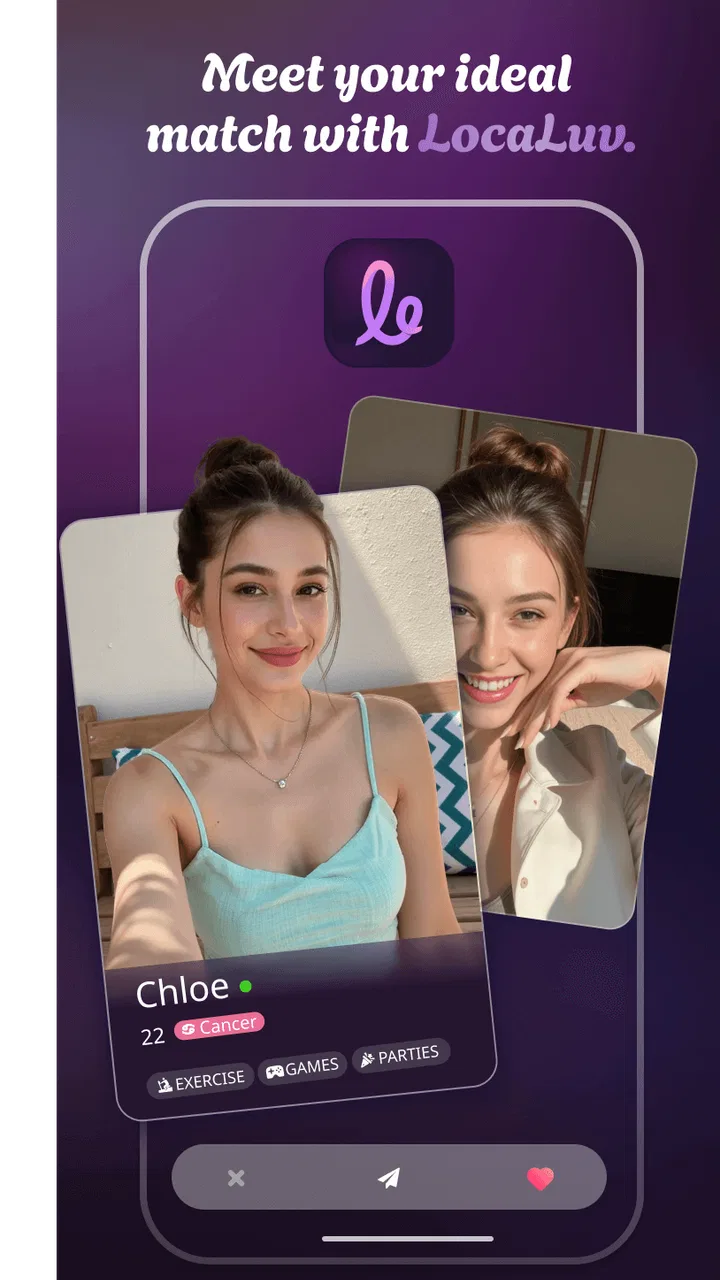
LocaLuv is a location-based social and dating app designed to help users discover and connect with people nearby. After creating a profile, you can browse suggested users, view shared interests and basic information, and decide whether to interact. Depending on the available features, connections may include likes, matches, messaging, or other social tools. The experience largely depends on your location and the number of active users in your area.
02Is LocaLuv free to download and use?
LocaLuv can generally be downloaded at no cost, but some features may require payment or a premium subscription. Free access may be limited to basic profile browsing, matching, or communication options, while advanced filters, increased visibility, unlimited interactions, or other extras could be reserved for paying members. Before subscribing, review the pricing, renewal terms, and cancellation rules shown in the app store or inside the application.
03Does LocaLuv protect my privacy and personal information?
Because LocaLuv may use location data, profile details, photos, and communication information, privacy settings deserve careful attention. During setup, check which permissions are requested and only enable access that you are comfortable granting. Read the app’s privacy policy to understand how information is collected, stored, shared, and deleted. Avoid publishing sensitive details such as your home address, workplace, financial information, or identity documents.
04Is LocaLuv safe for meeting people online?
LocaLuv may provide tools for discovering nearby users, but no dating or social platform can guarantee that every profile is genuine or trustworthy. Keep conversations inside the app until you feel comfortable, avoid sending money or private documents, and be cautious of requests that seem urgent or suspicious. If you meet someone in person, choose a public location, tell a trusted person your plans, and use the app’s blocking and reporting features when necessary.
05What should I do if LocaLuv does not work correctly or I want to delete my account?
If LocaLuv crashes, fails to load profiles, or has trouble with messages or location detection, first check your internet connection, update the app, restart your device, and verify that required permissions are enabled. If the issue continues, contact the developer through the official support channel. To leave the service, look for account or privacy settings that offer profile deactivation or deletion, and separately cancel any active subscription through Google Play or the App Store.
Pros
- Helps discover nearby people with shared interests and dating goals.
- Location-based matching can make arranging in-person dates more convenient.
- Profile browsing is simple and easy to understand for new users.
- Useful for meeting people outside your existing social circle.
- Push notifications can help you respond to new matches promptly.
Cons
- Location sharing may raise privacy concerns for cautious users.
- Match quality can vary significantly depending on your area.
- Some useful features may require a paid subscription or credits.
- Inactive or incomplete profiles can make browsing frustrating.
- As with any dating app
- users should stay alert for fake profiles and scams.

LocaLuv
Gallery